

We are currently living in “Interesting Times”. While this may be good news for journalists and the 24×7 rolling news cycle, it’s not necessarily good news for those of us who use Azure or, indeed, do any kind of international trade.
You may be tracking your costs in Azure – you should be tracking your costs in Azure, and if you want, we can help with that, but that’s not the point of this article.
You may be trying to stabilise your costs and budget by using longer-term leases with Azure Reservations. This makes sense if you know you’ll need that resource for that time, and it can give a significant discount, but it’s not a guarantee of costs.
We Have Reserved Instances
So you signed up for a three year deal to keep costs down and more predictable. But while Reservations can make Azure spend more predictable, they can’t make it completely static. You’ll be OK if you’re paying in USD, but if your organisation is billed in any other currency, you’ll be subject to the vagaries of exchange rates when buying any Azure service.
A Blast from the Past
Cast your minds back to the tail end of 2022. We had a query come in from a client who had wanted to know why their reserved instance pricing had gone up by 10% for October and then gone back down again in November.
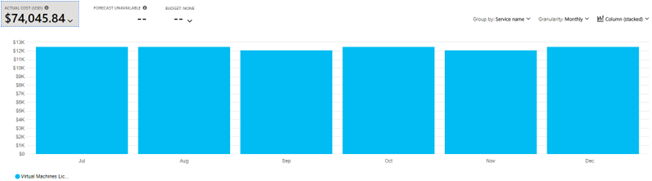
Microsoft Azure pricing is in USD. Looking at the dollar costs, we can see only the slight variations expected, thanks to the hourly cost being multiplied by the different numbers of hours in a month:
When converted into local currency (GBP) for billing, however, we see a different story:
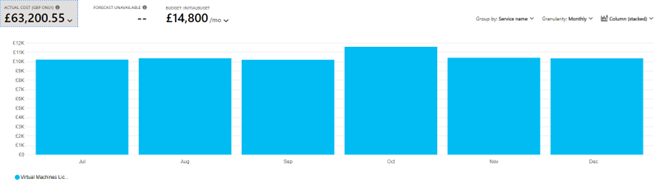
Most months, the price seems broadly similar. October, however, a spike, and back to expected levels in November.
What happened? Why did the price suddenly go up and then drop back down?
This is a combination of how Microsoft’s pricing is calculated, and the impact of politics on the mundane.
Microsoft’s pricing for Azure services is in US Dollars. This is then changed monthly to a local currency for billing. From the Azure pricing FAQ:
What exchange rate will be used and how does it work with my bill?
We use London closing spot rates that are captured in the two business days prior to the last business day of the previous month. If the two business days prior to the end of the month fall on a bank holiday in major markets, the rate-setting day is generally the day immediately preceding the two business days. This rate applies to all transactions during the upcoming month and will be applied to all Azure purchases and all Azure consumption in that month.
(In 2022, they used Thomson Reuters benchmark pricing, but the effect was the same.)
In September 2022, there was a mini-budget in the UK that led to a brief but significant reaction in the currency markets. This caused the UK pound to fall at just the wrong time of the month for those of us with Azure bills to pay.
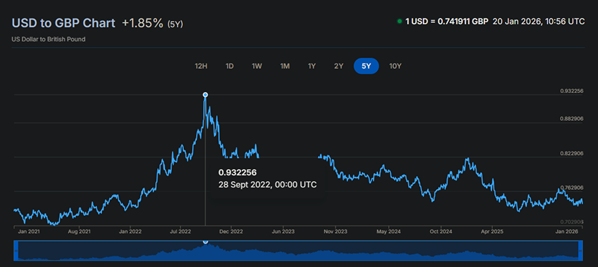
(chart from https://www.xe.com/en-gb/currencycharts/?from=USD&to=GBP&view=5Y)
That peak high rate lasted only a few days, but it was enough and at the wrong time, and so Azure prices went up.
Interesting Times
Although “May you live in interesting times” may not actually be an ancient Chinese curse, the sentiment is there. And I, for one, would rather not live in interesting times, if only to avoid having to have this sort of conversation with clients…