

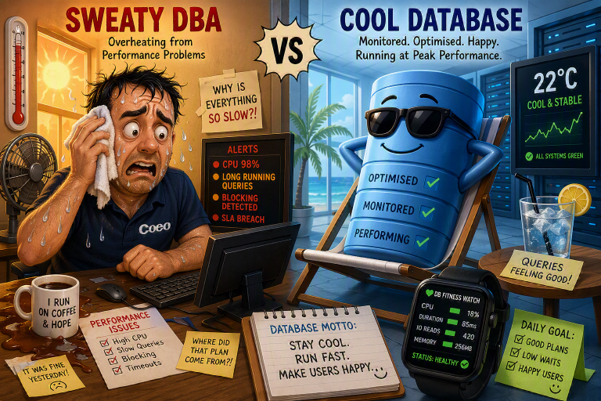
When the temperature rises outside, don’t let your databases start sweating too.
While many of us are dreaming about ice cream, cold drinks, and finding the nearest air-conditioned room, SQL Servers can have a very different summer experience. As workloads increase, deployments continue, and overnight processing grows; databases can start showing symptoms of running hot long before anyone notices.
Much like a DBA on a crowded train during a July heatwave, a database under pressure won’t always announce that it’s struggling. Instead, performance slowly degrades, CPU usage creeps up, reports begin taking longer, and overnight jobs start overrunning their SLA windows. By the time users notice, the system is already dripping with performance problems.
The Hidden Heatwave Inside Your Database
Like British weather, the Query performance regressions are notorious for appearing without warning. They can arrive after:
- Application deployments
- Query plan changes
- Index modifications
- Statistics updates
- Parameter sniffing issues
- Query optimiser decisions that looked clever at the time but had other ideas later on.
One minute your query is happily jogging along; the next, it has swapped trainers for flip-flops and is attempting a marathon through treacle.
The challenge is that traditional monitoring often spots the problem only after users start noticing or raise issues. At this point, the users, stakeholders, systems and applications are sweating or halting with the stress. The standard Query Store interface is powerful, but it’s largely reactive and requires manual investigation. It doesn’t naturally provide automatic alerting, centralised historical analysis, or cross-database visibility.
Tuning Up the Monitoring Before the Temperature Does
To tackle this challenge, I developed a Query Store Regression Monitoring solution designed to identify performance regressions as soon as they occur. The objective was simple:
Detect genuine query regressions across databases before users start melting down.
The solution compares the most recent Query Store interval with the previous interval, analysing changes in:
- Duration
- CPU consumption
- Memory usage
- I/O activity
Rather than relying on someone opening Query Store and manually hunting for trouble, after a problem has occurred the process continuously looks for queries that have become three times slower or worse than they were previously. Think of it as giving your SQL Server its own fitness tracker.
From One Database to Many
One limitation of many Query Store investigations is that they’re performed on a database-by-database basis. That’s manageable when you have one or two databases.
Less so when you have dozens. The monitoring framework scans multiple databases, collects performance information centrally, and records regressions in a shared repository for historical analysis and reporting. Instead of asking:
“Which database is causing the issue?”
You can immediately answer:
“Database X has a query that’s suddenly running 4.5 times slower than it was 15 minutes ago.”
That’s the difference between finding the fire extinguisher and already having water on the flames.
No More Waiting for The Fire Alarm
Anyone who has worked in operations knows there’s a fine line between useful monitoring and alert fatigue. No more Chasing False Alarms as nobody wants their phone buzzing at 3 a.m. because one query had a moment of existential crisis.
To reduce noise, the framework:
- Only logs genuine regressions
- Retains historical occurrences
- Evaluates performance over the previous 24 hours (Configurable)
- Requires repeated evidence before raising alerts (Configurable)
This helps smooth out temporary spikes whilst ensuring genuine issues are identified quickly. In other words:
You probably wouldn’t buy an air conditioning unit for a single day of hot weather. But with recent summers bringing record numbers of 34°C days, who would have predicted that? The lesson is the same in the database world: waiting until the heatwave arrives is rarely the best strategy.
Having the right proactive monitoring in place means you can spot performance issues before they become a crisis. It’s the equivalent of installing the air conditioning before the temperature hits unbearable levels. When you know the heat is building, you can act early and keep both your systems and your DBAs cool under pressure.
After all, one sweaty query doesn’t trigger an emergency. Ten sweaty queries in a row probably deserve attention. And if your database has the equivalent of a fitness watch continuously tracking its health, you’ll know exactly when it’s starting to overheat long before the DBA starts sweating through their Coeo polo shirt.
How It Works
At a high level, the process is straightforward:
- Identify the two latest intervals.
- Extract query performance statistics.
- Apply optional include/exclude filters.
- Compare previous and current performance.
- Calculate regression.
- Log significant regressions centrally.
- Alert when thresholds are exceeded.
The solution is lightweight, leverages existing Query Store data, and avoids introducing significant monitoring overhead.
Benefits for DBAs
The operational benefits are substantial:
- Early detection of performance issues
- Automated monitoring without manual intervention
- Consistent monitoring across multiple databases
- Centralised history for trend analysis
- Integration with SQL Agent alerts, email, and PagerDuty workflows
More importantly, it helps move performance management away from:
“The customer says everything is slow.”
towards:
“This query regressed by 320% at 14:15 and here’s exactly when it happened.”
Final Thoughts
Summer is hard enough without performance incidents turning your database environment into a digital sauna.
If your SQL Servers are working overtime, handling larger workloads, or supporting business-critical applications, relying on users to discover regressions is a risky strategy. By the time complaints arrive, your systems may already be overheating.
Query Store gives us the raw information. Combining it with automated regression detection transforms it into a proactive monitoring solution that catches problems early, reduces firefighting, and helps keep both your databases and your DBAs from breaking into a sweat.
So next time the weather forecast warns of a heatwave, ask yourself:
Is your DBA sweating because it’s summer… or because your database is running hot? 🔥