

A Summer in Managed Service Support
The UK doesn’t usually do hot weather very well.
Offices get warm, laptops get warmer, and suddenly everyone is trying to remember where they left the desk fan from last summer.
While most people are looking forward to a holiday or hoping the weather lasts until the weekend, life in Manage Services carries on as normal. Production systems don’t know it’s sunny outside, and they certainly don’t wait until Monday morning before deciding to cause a problem.
For us at Coeo, summer is often just as busy as the rest of the year.
Summer doesn’t mean quiet
People often assume things slow down over the summer, but that isn’t always true.
In fact, many organisations use the quieter business period to carry out infrastructure upgrades, cloud migrations and planned maintenance. At the same time, IT teams are taking well-earned annual leave, which makes having the right support in place even more important.
Over the past few weeks alone, we’ve been helping customers with AWS migration planning, analysing storage performance, investigating SQL Server cluster failovers, tuning performance, carrying out health checks and supporting production environments around the clock.
For us, that’s just a normal week.
Summer holidays don’t stop Data Platforms
Summer also brings another challenge that every IT team knows well—people take holidays.
Whether it’s a DBA taking a couple of weeks off, someone unexpectedly off sick, or a key engineer moving on to another project, production databases still need looking after. A Server doesn’t know that your database expert is sitting on a beach somewhere.
That’s one of the reasons many organisations choose managed service support.
Instead of relying on one individual, they have access to an experienced team of Data Platform engineers. If one engineer is unavailable, another can pick up where they left off. If an alert arrives overnight or during a holiday, there’s still someone available to investigate.
Earlier this year we wrote about this in our blog, “Beyond Managed Databases: Why Holiday and Sickness Cover Actually Matters.” The message is simple: good support isn’t about one person knowing everything—it’s about having a team with shared knowledge, documented processes and enough depth to provide consistent support whenever it’s needed.
You can read it here:
Keeping an eye on things
One of the biggest changes in Managed Service support over the years is how much emphasis is now placed on proactive monitoring.
It’s far better to spot a database running out of space or replication falling behind before a customer notices.
That’s why we spend so much time monitoring data estates, reviewing alerts and investigating trends. Quite often, customers never know there was a problem because it was identified and resolved before it had any impact.
That’s exactly how we like it.
Not every alert becomes an incident
Every DBA knows that alerts don’t always mean disaster.
Sometimes it’s a genuine issue that needs immediate attention.
Sometimes it’s a backup running longer than expected.
Sometimes it’s planned maintenance.
Sometimes it’s a failover that works exactly as designed.
The important part isn’t the alert itself; it’s understanding what’s actually happening and knowing when action is needed.
That experience comes from supporting many different data platform environments rather than seeing the same systems every day.
Staying cool
People often ask what it’s like working in Managed Service support.
The honest answer?
Some days are quiet.er than others.
Other days you can be working on a migration, helping a customer investigate performance, reviewing an RCA, assisting with a cloud migration and answering an urgent support call, all before lunch.
Keeping calm is probably one of the most useful skills you can have.
Having good monitoring, clear runbooks and a team that shares knowledge certainly helps too.
A few summer essentials
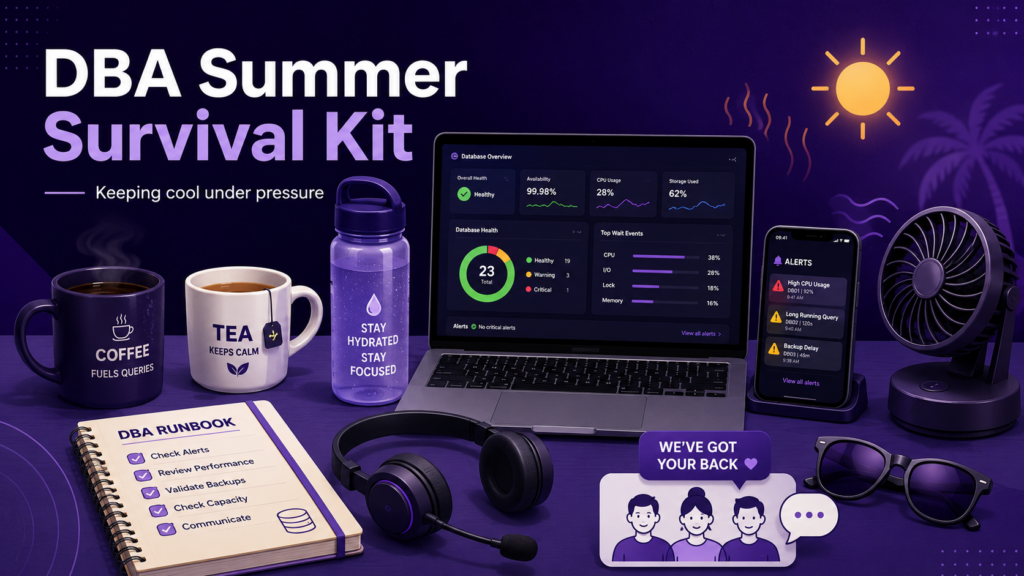
Every Data Platform engineer probably has their own survival kit.
For most of us it includes:
- Coffee (or tea, depending on which side of the office debate you’re on).
- A water bottle that never seems to stay full for long.
- Plenty of monitoring dashboards.
- PagerDuty notifications.
- A decent fan somewhere nearby.
- Colleagues who are happy to jump in when things get busy.
And yes, occasionally someone admits to putting their T-shirt under a cold tap before the next Teams meeting…
We won’t say who.
Final thoughts
Whether it’s the middle of winter or the hottest week of the year, our customers still rely on their Data Platform environments being available.
That’s what managed support is really about.
It’s not just fixing problems when they happen. It’s monitoring systems, spotting issues early, sharing experience across different customers and making sure there’s always someone available, even when your own team is enjoying a well-earned holiday.
Hopefully, the sunshine sticks around for a while.
The alerts probably will too.